

(April 29, 2011 - by Ralph Kurtenbach) Two cultures are blended at Alfredo and Alex Leon's home in Shell, Ecuador-British and Ecuadorian.
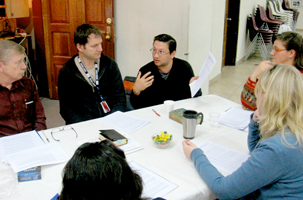 It's a harmonious relationship but not without sporadic cultural tensions, according to the couple who shared their experience with other attendees of a March intercultural communications seminar in Quito, Ecuador.
This HCJB Global Hands couple faces two or more additional cultures as they travel to Ecuador's Amazon region to promote, design and help construct clean water projects in underserved jungle communities. The rainforest they visit most is home to the Shuar, Achuar and Waorani-indigenous groups whose older leaders continue an oral tradition. Some are a world apart from computer software designs of projects or engineering equations.
To top it off, Alfredo and Alex Leon work frequently with U.S. missionaries, or as Alex put it, "the Americans." You might think there would be no better candidates to take a cross-cultural communications seminar!
But then there's Tannia Lascano, an Ecuadorian mestiza (blended Hispanic-indigenous heritage) who offers hygiene talks with the clean water projects team. "Ecuador is a blend of cultures by itself," Lascano said. "I am a mestiza, but I work with indigenous Quichua and with mestizos too."
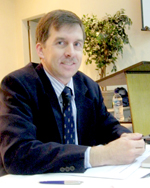 |
| Dr. Stephen Hawthorne |
In addition, she interfaces with the British and American cultures. Lascano was among 50 people from several cultures who attended the course, jointly sponsored by Wheaton College and HCJB Global. Dr. Stephen Hawthorne and his wife, Mary, a missionary couple with SIM in Bolivia, led the five-day event in Quito, Ecuador. Interested participants received Wheaton College credits for completing assigned readings and essays for the course.
"I like Steve's style-lots of examples and [he] makes himself vulnerable by showing his own examples," Alex said weeks after the conference had ended. Asked if she'd applied the principles learned, she replied, "My marriage . . . and my in-laws."
Alfredo also mentioned putting the Wheaton course to work in the Leon home, adding that it has helped in working with colleagues and his foreign supervisors.
"The U.S. and Ecuador are at extreme ends of the scale of individualist/collectivist cultures," said Bruce Rydbeck, another attendee. An American engineer, Rydbeck's work with clean water projects in Ecuador's mountain region takes him into many Quichua Indian communities which take the collectivist approach even further.
Time-oriented and project-focused, Rydbeck has learned during three decades in Ecuador that others do not view life in the same way. "Personal relationships are much more important to Ecuadorians than accomplishing goals." He both values and contributes to what he considers a bicultural balance to confront a desperate need for clean water, especially in the rural areas.
"The indigenous communities are motivated by their need to take action regarding their water supply in spite of the cultural factors," Rydbeck added.
Alex said small-group exercises aided seminar attendees to process the concepts learned. "In my groups the Ecuadorians/Latinos could see the other side, but the Americans in our group would resort to the biblical way," she explained. "They couldn't see that maybe they weren't correct in a Latin culture."
"Too often the Bible is read in one's own culture, taken as right and then taught in other cultures, and it is no longer culturally correct," Alex continued. "We need to read from the cultural perspective and know what is biblical and what is bad culture and can be changed. Some Bible studies looking at the differences in culture in the Bible would be good."
Alfredo added that Hawthorne "went beyond theoretical learning to the practical, studying real cases."
Concurring was another participant, Michelle von Debschitz, a speech pathologist and former HCJB Global working visitor who has trained Hospital Vozandes-Quito staff in procedures to correct swallowing disorders. She pointed out that Hawthorne set up cross-cultural scenarios to illustrate real-life challenges. "Sometimes no matter with what attitude when something is offered, people are not ready to receive it," von Debschitz, explained. "In that activity, we had to consider that."
Several of the seminar participants are being mentored by HCJB Global and partner ministries in a missionary mobilization initiative called Corrientes (translated as "currents"). Corrientes aims to help prepare Latin American bi-vocational missionaries to serve in other parts of the world.
"I believe the entire mission would do well to learn these principles to understand the situations that can cause pain and misunderstandings," Lascano said. "It would be a heart cleansing time."
Source: HCJB Global
Colorado Springs, CO 80949-9800
800.873.4859