

MENU
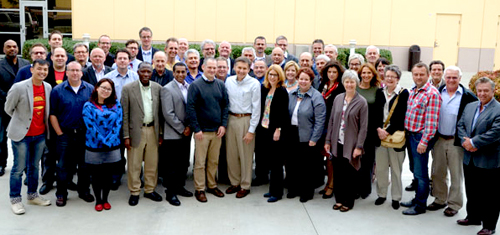 |
| Fifty-three Christian media professionals from around the world participated in the Lausanne Global Consultation on the Gospel and Media Nov. 18-21 in Los Angeles. |
This was what HCJB Global President Wayne Pederson described as a key "takeaway" at the Lausanne Global Consultation on the Gospel and Media in Los Angeles Nov. 18-21. The event brought together 53 Christian media professionals from around the world.
When Theo Asare, the mission's media partner in Accra, Ghana, illustrated the importance of partnership at the conference, he told the "elephant story." It's the tale of an African villager who managed to trap an elephant in a deep hole. But not wanting to share his good fortune with others who offered to help him retrieve the animal in exchange for a portion of the meat, he refused their help. As a result, the elephant rotted in the pit and went to waste, benefitting no one.
"Theo called his partnership with HCJB Global, Faith Comes by Hearing and local partners as central to his effectiveness in spreading the gospel across West Africa," explained Pederson, who served as chairman of the event. "He also used the New Testament story of the crippled man who was lowered through the ceiling as a jumping-off point. They saw the need, they were creative and they took risks."
Lars Dahle, Lausanne senior associate for media engagement, added, "If the whole church is to take the whole gospel to the whole world, media engagement becomes a highly significant issue."
Phil Cooke, cofounder and president of Cooke Pictures, led the first evening plenary session and spoke on the inundation of information and media in the world. "[As a result] it's not the best message that gets through anymore; it's actually the message that knows how to cut through all that clutter and get on the radar and get noticed," he said.
Highlighting case studies from global brands such as Nike and Starbucks, Cooke explained the necessity and importance of branding "in a culture of unlimited choice." He challenged participants, "Everything communicates. How does your story cut through?"
Participants at the consultation came from traditional to new-media backgrounds, including radio, television, film, journalism and social media. "These leaders were chosen as participants because of their expertise, their passion to use media for mission and evangelism, and their desire to intentionally collaborate together," said Naomi Frizzell, participant selection team convener and vice president of global media at RBC Ministries.
Learning that YouTube has "more content than CBS, ABC and NBC combined," delegates also learned the importance of using television and videos to tell stories visually, but the quality must be there to gain people's attention and trust.
The consultation emerged from the Cape Town Commitment's call for a "renewed critical and creative engagement with media and technology."
Task forces focused on a specific media platform. "I was amazed and surprised at the high level of engagement and passion of participants from around the world with a common passion for media outreach," remarked Pederson. "The high level of interaction and energy was an inspiration and encouragement to those who work faithfully to share God's love through the diverse media tools God has given us today."
Participants were challenged by Ruth Limkin, executive officer to the speaker of Queensland Parliament in Australia, to leverage social media and create opportunities to engage in public conversations that are "gracious" and "brave."
Citing compelling examples of positive blog posts that led to significant and tangible change, she challenged participants to use media to call people to a positive vision of what could be rather than simply criticizing people. "It's more effective to give people a bigger vision to say yes to than focusing on what we want them to say no to," Limkin said.
"Our prayer is that years from now we will look back at the consultation as a seminal moment in engaging the next generation with the good news that we can be winsome, influential and effective in sharing God's redemptive plan to a broken world," added Pederson. "By the time we concluded, this diverse team of media professionals uncovered strategies and tools, which will allow us to use media, especially social media, to engage the culture and reach the hard to reach places where Christ is not known."
"Using social media to get across your message is cost-effective, democratic (anybody can do it) and measurable," Pederson explained. "You can track how many people are downloading or streaming your message. It's relational in that you can connect around the world. With Facebook you get an opportunity to get a reacquainted with people."
Henryk Krol, founder of CCM Media, HCJB Global's Polish partner, also took part as a panel member at the consultation. "His ministry uses radio to draw people to the website, and they use the website to reach people with the gospel," Pederson related. "They assign personal coaches to do discipleship in partnership with Jesus.net. They've had 2 million hits; 200,000 say they have accepted Christ. About 10 percent of these have e-coaches to answer their question, so about 20,000 people have been reached in this way."
"We need to be better at telling stories," concluded Pederson. "Stories are compelling and they're memorable. They get repeated, especially in an oral culture. Jesus communicated by asking questions and telling stories, and we can learn from that today."
Sources: HCJB Global, The Lausanne Movement
P.O. Box 39800
Colorado Springs, CO 80949-9800
800.873.4859
Colorado Springs, CO 80949-9800
800.873.4859