
Please login to continue
Having Trouble Logging In?
Reset your password
Don't have an account?
Sign Up Now!
Register for a New Account
Name
Email
Choose Password
Confirm Password

Medical Team from Ecuador Prepares for Cholera Response in Haiti

June 4, 2011

Medical Team from Ecuador Prepares for Cholera Response in Haiti

June 4, 2011

(June 3, 2011 - by Ralph Kurtenbach) An international team of medical professionals is set to leave Ecuador on Saturday, June 4, to spend two weeks responding to an urgent need to care for cholera patients in Haiti.
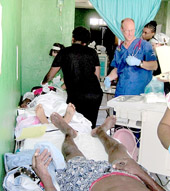
Dr. Mark Nelson helps cholera
patients during an outreach
in November 2010.

In Ecuador, physicians Dr. Mark Nelson and Dr. Mattias Egberth, along with nurses Kim Kirk and Sandra Paredes, moved quickly. They will travel to a rehydration center at Cité Soleil where cholera patients are already receiving intensive oral and intravenous rehydration at a facility operated by Samaritan's Purse (SP).

HCJB Global's Hermann Schirmacher received an urgent appeal earlier this week to help out at SP's tent medical facility that is full of cholera patients. "They (SP's staff) know us-that we're very flexible," Schirmacher said. "We're agile, we can quickly put together a team, and we're close by. We don't have to travel across half the continent to get to the Caribbean."

Dr. Mark Nelson urged prayer "that our team would work well together and for strength and wisdom in dealing with patients with complex cases."

SP established the Cité Soleil rehydration center near Haiti's capital to confront a cholera outbreak that began in late 2010. At that time HCJB Global Hands responded with two medical teams, one of which Schirmacher led in mid-December.

By Tuesday, May 31, the SP triage tent was completely full, according to the North Carolina-based mission's website. "Our volunteer work crew came out to help hang intravenous boards and build another triage tent to handle the load," the site reported. In just one day last week, nearly 100 patients were treated in the tent.

The cholera center is a 200-bed facility located near a church, school and clinic. It's in an area where a large "tent city" was set up after Haiti's devastating earthquake in January 2010.

Upon his return from a mobile medical clinic in rural Ecuador, Dr. Steve Nelson outfitted the team with antibiotics, oral rehydration packets and intravenous kits for fluid replacement, iron for anemia, antifungal medicines, asthma medications and vitamins to take to Haiti.

As with earlier HCJB Global Hands teams that responded to Haiti's devastating earthquake and subsequent health crises, this team is also international. Nelson is a U.S. citizens with decades of overseas living-primarily in Venezuela and Ecuador. More recently, Kirk came to Ecuador from the U.S., and Egberth is a Swedish surgeon. Paredes is an Ecuadorian who had served temporarily at Pioneer Christian Hospital in Impfondo, Republic of Congo, in 2008.

Cholera causes severe, dehydrating diarrhea. During cholera relief work in Haiti last November (his third trip in 2010) Mark Nelson wrote, "It's really sinister how quickly and quietly patients go down. The volume of fluid lost [goes] really fast." Left untreated, the malady can kill children and adults in fewer than 12 hours.

The cholera strain that swept through areas of Haiti made its first appearance there in nearly a century. Among the first victims were people living near a U.N. outpost in Mirebalais.

This month a U.N. panel that investigated the 2010 outbreak found "circumstantial evidence suggesting that U.N. peacekeepers may have introduced a lethal strain of the disease into the Haitian population," reported The Washington Post. The late 2010 outbreak killed an estimated 4,500 Haitians while sickening another 300,000.

Although team members don't know exactly what to expect, their biggest concern could be the weather. "There is a 30-percent probability of a cyclone forming during the next 48 hours," said Schirmacher. "I don't expect any problem with our flight, but there could be heavy rains during our time in Haiti."

Sources: HCJB Global, Samaritan's Purse, The Washington Post

Director of Church & Donor Partnerships

Position Summary: The Director of Church & Donor Partnerships strengthens Reach Beyond’s ministry by cultivating purposeful, trust-based relationships with churches, pastors, donors, and mission-minded individuals. Serving as a storyteller, encourager, and connector, this role invites the Body of Christ to join in God’s mission to reach those with little or no access to the Gospel.

Working closely with the Mobilization and Development teams, this person helps raise up new workers, strengthen church partnerships, and resource strategic ministry initiatives—always with a posture of discernment, prayer, and long-term stewardship.

Location: Colorado Springs or remote

Employment Type: Full time with employer-paid benefits, including medical coverage, retirement plan, and paid time off.


What This Role Does (Core Responsibilities)

1. Church Partnership Development

This role serves as a relational bridge between Reach Beyond, churches, and missionaries.

The Director:

  • Maintains strong relationships with existing partner churches and develops 2–4 new church partnerships annually
  • Shares the vision of Reach Beyond, helping churches understand and engage with the needs of the unreached
  • Equips churches with resources that support missionaries and foster long-term, healthy partnerships
  • Collaborates closely with missionaries as they engage their sending and supporting churches

2. Donor Ministry & Stewardship

This role views donor relationships as ministry and discipleship, not transactions.

The Director:

  • Manages relationships with approximately 12 key donor accounts
  • Walks alongside donors with discernment—guiding them through education, cultivation, solicitation, and appreciation
  • Communicates clearly about ministry priorities, impact opportunities, and project funding goals
  • Maintains accurate, timely records in the donor management system to ensure thoughtful follow-up and accountability

3. Representation & Engagement

This role serves as a public voice and relational presence for Reach Beyond.

The Director:

  • Represents Reach Beyond at 3–5 regional or national events annually, with intentional follow-up for every connection
  • Communicates the story of God’s work in Reach Beyond through stage presentations, small groups, and media opportunities
  • Participates fully in staff meetings, chapels, retreats, and organizational prayer rhythms

4. Reporting, Collaboration & Administration

This role balances relational ministry with faithful stewardship and teamwork.

The Director:

  • Provides quarterly written reports tracking progress toward mobilization and development goals
  • Works closely with the Mobilization and Development Directors to align efforts and communicate organizational priorities
  • Upholds organizational policies and maintains healthy, proactive communication across teams

You must be authorized to work in the United States.

We participate in the federal E-Verify program. See more information at:

https://reachbeyond.org/e-verify-right-to-work.pdf
https://reachbeyond.org/e-verify-participation.pdf


Why Join Reach Beyond? At Reach Beyond, we cultivate a culture rooted in relationship, collaboration, and dependence on God. Our mission is to see unreached people transformed in Christ through media, healthcare, and community development. As the Director of Church & Donor Partnerships, you’ll play a vital role in advancing God's mission and have the opportunity to grow personally and professionally while making a lasting global impact.

All applicants must be able to sign the Reach Beyond Statement of Faith.

Apply Now: Join us in fulfilling God’s calling to bring hope and transformation to the unreached. Complete the application here.  Contact [email protected] if you have questions.