

 |
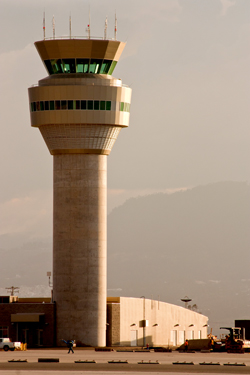
| The lone control tower at the new Quito airport 11 miles east of the city. Regular flights at the facility are expected to begin in February. Photo courtesy of Quiport. |
(Nov. 30, 2012 - by Ralph Kurtenbach) Rising above a rapidly urbanizing valley of greater Quito, a tower stands above an airstrip in the rural parish of Tababela.
The lone tower overlooks the much-heralded new international airport for the Ecuadorian capital. First proposed as long ago as a quarter century and now finally a reality, the new airport is projected to begin receiving flights in early 2013.
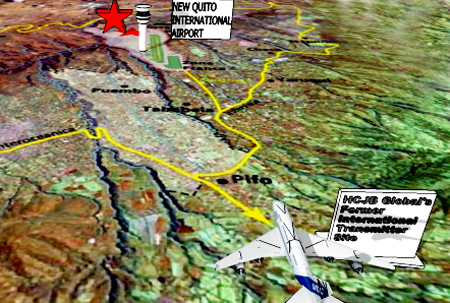
Just a few miles away, no towers remain in Pifo where the 110-acre site served for decades as the international transmitter site of Radio Station HCJB, the "Voice of the Andes." To shortwave radio listeners near and far, the station's call letters, HCJB, had become synonymous with its mission of "Heralding Christ Jesus' Blessings."
The mission had purchased the land 18 miles east of Quito in the 1950s and developed it to the point where it housed 11 shortwave transmitters with a combined power of more than 1 million watts. Thirty-two antenna systems were supported by 48 towers that ranged in height from 30 to 417 feet.
After the last of the transmitters was shut off in 2009, former HCJB Global missionary Ken MacHarg wrote of the silence of the "transmitters that labored day in and day out to transform the programs into a signal that would be carried around the world." MacHarg had served as a program announcer and also headed English-language programming during the 1990s.
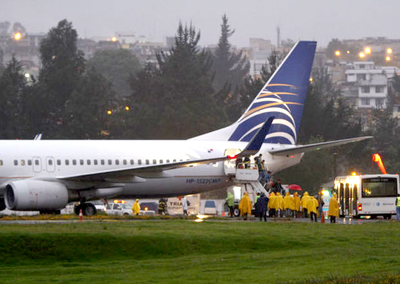 |
| Passengers evacuate from a Copa Airlines plane after it overran the relatively short runway at Quito's Mariscal Sucre International Airport. Photo courtesy of El Comercio. |
As new airport preparations continue at Tababela, 11 miles east of Quito, an incident occurred at Quito's Mariscal Sucre International Airport when a Copa Airlines plane overran the runway at 5:32 p.m. Thursday, Nov. 29, after a late-afternoon rain.
After fire truck and ambulance crews responded at the scene, Fernando Guerrero, the director of Civil Aviation, advised via his Twitter account that airport operations were suspended, attributing weather conditions as the cause of the incident. Flights were redirected to Manta, Latacunga and Guayaquil until Quito operations returned to normal. There were no injuries.
Authorities hope to avoid such incidents at the new airport which boasts a 4.1-km (2.5-mile) runway, longest of any international airport in South America. It's also farther from the mountains and not surrounded by houses or other structures as is the present airport.
The former Pifo antenna site may now resemble its pre-1953 state before antenna construction, according to Hermann Schirmacher of HCJB Global, whose family lived in the area in 2010-2011 when the last towers were dismantled.
 |
|
Planes apporoaching the new international airport east of Quito will fly above HCJB Global's former international transmitter site in Pifo. |
"There was a farmer growing crops there," he related. "They didn't grow too well, but it looked very nice with no towers-a very nice field." Authorities carved away some of the front side of the Pifo property when the highway was widened to four lanes.
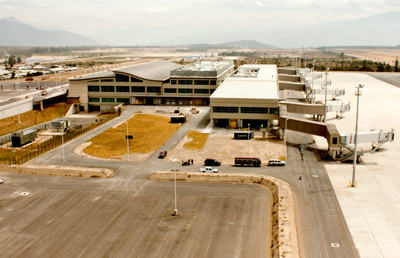
In September, dignitaries boarded a plane at the Tababela airport and took off into the rarefied Andean air. A day later, a cargo plane touched down on the runway. Then on Oct. 11 the Quiport Corporation formally delivered to Quito Mayor Augusto Barrera what the consortium called "substantial completion of works" of the new Quito international airport. Barerra, along with various national officials, landed in an Airbus 319-part of the fleet of the Ecuadorian airline, TAME. Commercial flights are expected to begin on Feb. 20, 2013.
Three years after an end to the broadcasts from Pifo, some of these same shortwave radio transmitters are sending programming to audiences in various Asian countries and the Pacific from HCJB Global-Australia's international broadcast facility in Kununurra, Australia.
The mission's media leadership team, however, has also steered a greater emphasis toward radio planting-helping local ministries start and operate radio stations. Some local partners have linked their stations with health clinics, modeling the mission's ideal of combining ministries to maximize community outreach with Christ's love.
 |
|
Quito's new international airport will officially open on Feb. 20. |
As part of this thrust, the ministry helped establish an internet radio station in Russia. David, who directs the mission's Europe/Eurasia Region, referred recently to "several Russian partners broadcasting on the Internet" and described the audience as young people "who appreciate the music mix along with opportunities to engage in spiritual discussions on the website."
David said that "radio listeners, mostly in villages, are still being taught and blessed through the ministry of the Voice of the Andes which is still remembered in Russia." Programs continue to air from a shortwave site in Europe.
For Radio CCM in southern Poland, a vibrant Internet ministry complements its network of six FM stations, serving a weekly audience of nearly 600,000. One of those listeners is Liliana, a Polish cancer survivor who was coached by an online counselor, Theresa. (The term used by CCM is e-coached). The online Bible study "Why Jesus?" answered many of Liliana's questions, followed up by the Alpha course at a local evangelical church, and she has become an e-coach.
Radio CCM launched its evangelistic website in 2008, a Polish version of the website, www.lookingforgod.com. "They seem to be doing a great job and use the radio to point people to the website for more information," observed Perry Beabout, a missionary serving at the HCJB Global Technology Center in Elkhart, Ind.
In Ecuador, meanwhile, Radio Station HCJB is set to launch its own youth-oriented web page with a music stream, Control Z.
In addition, English Conversation Clubs, begun more than a decade ago in a Quito church to complement programming on Radio Station HCJB, has added Internet venues to its repertoire of English-learning adventures. Internet conference calls allow moderators to invite learners from around the world, including limited-access countries. The English Conversation Project radio program scripts are also mailed electronically to 5,000 subscribers in Latin America alone.
Partnerships are essential to the mission's digital media strategy. In late 2012 the mission teamed up with partner broadcaster Feba UK to launch "OneSheep," a collaborative effort to research how young people communicate and consume media, then endeavoring to reach them with biblical truth. The consortium will place a priority on projects that impact unreached and limited-access people groups. These groups are embracing new media, particularly those that are delivered via mobile devices.
For people living in Brazil's vast Amazon basin who may still be behind the digital divide, HCJB Global, Word of Life-SEARA and In Touch Communications are joining forces to distribute MP3-like, preprogrammed audio players to different people groups.
What began with one microphone and one transmitter in a Quito living room on Christmas Day, 1931, has spread to numerous local ministries in different parts of the world, united in a relationship to HCJB Global but even more in a desire to continue Heralding Christ Jesus' Blessings.
Sources: HCJB Global, Corporación Quiport
Colorado Springs, CO 80949-9800
800.873.4859