
Please login to continue
Having Trouble Logging In?
Reset your password
Don't have an account?
Sign Up Now!
Register for a New Account
Name
Email
Choose Password
Confirm Password

Quichua Radio Program Producers in Ecuador Enter Digital World

April 15, 2011

Quichua Radio Program Producers in Ecuador Enter Digital World

April 15, 2011


(April 15, 2011 - by Ralph Kurtenbach)
After decades of hand delivering radio shows recorded on cassette to Radio Station HCJB in Quito, Ecuador, Quichua Indians who have faithfully produced the program are venturing into the digital realm with their program, El Amor que Transforma (Love that Transforms). 
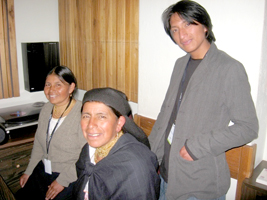
L-R: María Potosí, Mercedes Castañeda
and David Caluqui at studios in Quito.

The program participants are evangelicals who continue to produce half-hour programs on behalf of their church at Lago San Pablo just off the Pan-American Highway near Otavalo. Many from this large congregation make artisan wares available at the indigenous market at Otavalo, a favorite stop for tourists in Ecuador.

"I think the new program embraces everything-the new life that Christ brings as well as a cultural transformation that improves things in every sense," said Luis Santillan who oversees Quichua programming on HCJB-AM in Quito. Interviews, cultural segments and a community calendar complement a message that Jesus can change people's lives.

In traditional Otavalo Indian dress of white embroidered blouses and long dark skirts, María Potosí and Mercedes Castañeda represented others (including Castañeda's sister, Juana) in a recent visit to HCJB. They and David Caluqui talked to the engineering staff about recording equipment they plan to install at Divine Master of Galilee Church. The congregation is raising funds to complete this digital transition.

Caluqui, who speaks Cayambe Quichua, interpreted for Potosí and Castañeda, both native speakers of Otavalo Quichua. The two ladies described their program content during the last decades as "looking at women's situations."

They have encouraged harmonious relationships between spouses, and the programs have given Quichua women a voice, according to Caluqui. They also cover topics such as sound economic practices, health concerns and childcare.

File transfer protocol (FTP) does away with a required trip into Quito each week for program delivery. "They log on to the Internet, load it up on the FTP site and we download it," said Santillan with a chuckle.

Radio programs in the Quichua language have aired regularly on Radio Station HCJB since 1941. Some 40 years later the station's Quichua Service requested church participation in programming. Dozens of churches supplied programs, each with a unique local ambience. Just four churches continue the programming today, according to Santillan.

"Members of our congregation have heard us from the U.S.," added Castañeda. The Quichua have fanned out from tiny Ecuador to sell their artisan work-such as ponchos, embroidered tablecloths and woven wall hangings-elsewhere in the world to in turn wire funds back to their families.

"People have heard Ecuadorian music," Potosí recounted, adding that it has comforted listeners at great geographic distance from their families. "It has motivated them to continue growing in Jesus Christ."

The programs aired to a wide audience via international shortwave radio until Radio Station HCJB ended those broadcasts in 2009. Presently another ministry, Vozandes Media, airs them on shortwave frequencies even as HCJB releases them on AM radio.

Other indigenous Ecuadorian languages also air from a Vozandes Media 10,000-watt shortwave transmitter on Mount Pichincha above Quito. With production staff based in Ecuador, Vozandes Media is administrated by the HCJB Global World Office in Germany.

Changes have also occurred in the congregation at La Compañía, a church near Otavalo with several hundred members. A communications group continues to oversee the church's radio production efforts and HCJB-AM airs the women's program in the early-morning hours.

Holding the camera out front at arm's length, Caluqui photographs himself and the interviewer, and together they view the instant result. To an upcoming generation of Quichua believers, the transition to the digital realm seems already complete.

Source: HCJB Global

Director of Church & Donor Partnerships

Position Summary: The Director of Church & Donor Partnerships strengthens Reach Beyond’s ministry by cultivating purposeful, trust-based relationships with churches, pastors, donors, and mission-minded individuals. Serving as a storyteller, encourager, and connector, this role invites the Body of Christ to join in God’s mission to reach those with little or no access to the Gospel.

Working closely with the Mobilization and Development teams, this person helps raise up new workers, strengthen church partnerships, and resource strategic ministry initiatives—always with a posture of discernment, prayer, and long-term stewardship.

Location: Colorado Springs or remote

Employment Type: Full time with employer-paid benefits, including medical coverage, retirement plan, and paid time off.


What This Role Does (Core Responsibilities)

1. Church Partnership Development

This role serves as a relational bridge between Reach Beyond, churches, and missionaries.

The Director:

  • Maintains strong relationships with existing partner churches and develops 2–4 new church partnerships annually
  • Shares the vision of Reach Beyond, helping churches understand and engage with the needs of the unreached
  • Equips churches with resources that support missionaries and foster long-term, healthy partnerships
  • Collaborates closely with missionaries as they engage their sending and supporting churches

2. Donor Ministry & Stewardship

This role views donor relationships as ministry and discipleship, not transactions.

The Director:

  • Manages relationships with approximately 12 key donor accounts
  • Walks alongside donors with discernment—guiding them through education, cultivation, solicitation, and appreciation
  • Communicates clearly about ministry priorities, impact opportunities, and project funding goals
  • Maintains accurate, timely records in the donor management system to ensure thoughtful follow-up and accountability

3. Representation & Engagement

This role serves as a public voice and relational presence for Reach Beyond.

The Director:

  • Represents Reach Beyond at 3–5 regional or national events annually, with intentional follow-up for every connection
  • Communicates the story of God’s work in Reach Beyond through stage presentations, small groups, and media opportunities
  • Participates fully in staff meetings, chapels, retreats, and organizational prayer rhythms

4. Reporting, Collaboration & Administration

This role balances relational ministry with faithful stewardship and teamwork.

The Director:

  • Provides quarterly written reports tracking progress toward mobilization and development goals
  • Works closely with the Mobilization and Development Directors to align efforts and communicate organizational priorities
  • Upholds organizational policies and maintains healthy, proactive communication across teams

You must be authorized to work in the United States.

We participate in the federal E-Verify program. See more information at:

https://reachbeyond.org/e-verify-right-to-work.pdf
https://reachbeyond.org/e-verify-participation.pdf


Why Join Reach Beyond? At Reach Beyond, we cultivate a culture rooted in relationship, collaboration, and dependence on God. Our mission is to see unreached people transformed in Christ through media, healthcare, and community development. As the Director of Church & Donor Partnerships, you’ll play a vital role in advancing God's mission and have the opportunity to grow personally and professionally while making a lasting global impact.

All applicants must be able to sign the Reach Beyond Statement of Faith.

Apply Now: Join us in fulfilling God’s calling to bring hope and transformation to the unreached. Complete the application here.  Contact [email protected] if you have questions.