

MENU
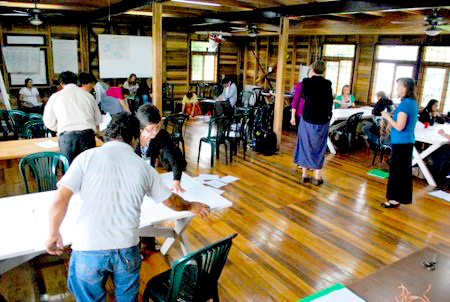 |
| Energizing community participation was at the heart of the lesson plans that HCJB Global healthcare workers developed during the workshop. |
With just a few years of formal education, the Ecuadorians of the Amazon basin demonstrated high levels of literacy in jungle life and lore. Manley, in acquainting himself with those who ran to the grass airstrips as his Mission Aviation Fellowship (MAF) plane touched down, found that his admiration for them only grew.
Their form of literacy manifested itself as wisdom, an ability to intuit from their environments and draw conclusions. These people of Ecuador's eastern jungles live, garden and hunt in some of the world's most diverse ecosystems. This greatly impressed Manley and his wife, Regina, who said, "The indigenous people practiced far better earth stewardship principles than the average foreign (white) visitors to the Amazon."
Now based at MAF's headquarters in Nampa, Idaho, the Manleys visited Ecuador this year to help with seminars in "Participatory Learning and Oral Strategies Training." They teamed up with Susan Etts and Richlyn Poor* as facilitators in sessions where participants, including several from HCJB Global, shared their collective wisdom.
"Trainer of trainer-style workshops are designed to equip field workers for areas with low literacy levels," said Etts of Lifewater International. "These methods are very effective for all learners, regardless of their level of literacy."
Etts, who in 2012 first collaborated with HCJB Global in Ghana, added that many of those she has trained possess literacy skills, including some with advanced degrees. "Many oral learners can read," agreed Regina. "They just don't enjoy learning from reading. Many skilled literate learners have a strong oral preference."
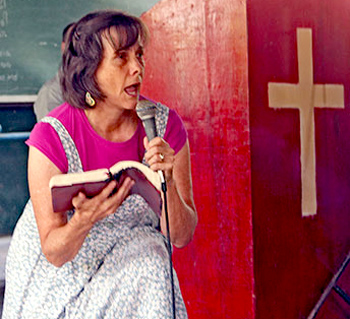 |
| Regina Manley shares a Bible story with 250 students in Thailand in 2009. |
Etts believes that everyone passes on their beliefs, heritage and values through stories, parables, proverbs, music, dance and other art forms. "Some people groups record these things in written form (or these days, digital form) and some do not," she said.
"I'm learning values from a story, whether I hear it told by a live storyteller, read it out of a book, or watch it on television or a DVD. There are people in highly literate cultures who prefer oral learning styles whether they know how to read or not," Etts continued. "The reality is that with the explosion of technology, print will become less influential than in the last century and video and audio will become more influential." A literate base of technicians must support the technology to be sure.
One participant already touching Ecuador's indigenous as well as mestizo cultures was Tannia Lascano, a health and hygiene teacher in HCJB Global's community development department. "I learned to trust more in the Holy Spirit as He is the one directing the way of teaching that in some cases will need to be more participatory than lecture or the other way around," she offered, recognizing that teaching styles each possess strengths and weaknesses. "We need to understand the importance of each and with the leading of the Holy Spirit we will know which one to use more."
Etts' work brings her into contact with non-readers and low level readers serving essential leadership roles in their communities. Their leadership uses few or no books, lectures, graphs, and visually displayed conceptual models, but primarily uses the spoken word.
"They have much wisdom and ability to teach others, regardless of their literacy level and are very effective change agents," she said. "It has humbled me to witness the creativity, quick minds, and eagerness exhibited by such leaders as they seek to implement their ideas in the midst of very great challenges."
Poor characterized Participatory Learning and Action (PLA) as a group of techniques for engaging communities in fruitful discussion. "PLA, when done well, tends to elicit high levels of community ownership and follow through," she explained. "Thus, leading to projects that are more likely to be successful in the long run."
Recitation is an aspect of learning, but Etts directs participants into group-implemented critical thinking through brainstorming as well as incorporating analysis tasks that utilize simple line drawings, creating maps, calendars and other diagrams. Poor said she curtailed the pedagogy in order to play up practice, including role playing and other activities.
While Poor's many years as a university lecturer sways her in that direction, she says that "because I have seen the power of having students do their own thinking and doing, I'm glad to have them do quality exercises as well. My work comes in making sure the exercises are high quality and appropriate for the group."
One thrust of the seminars-but not excluding other hopes-was more effective ministry outreach among jungle dwellers. Application of PLAs is broad as "everyone learns orally first" according to Regina.
To her, oral learning is not only first, it surpasses literate-style learning which is usually forgotten unless learners can refer to their notes. The Manleys, Etts and Poor required participants to blend Bible stories with health and community development lessons for a holistic gospel that touches all areas of life.
"The gospel according to Jesus is the gospel of the kingdom, far bigger than what many people think," Etts explained, adding that Jesus ministered to people's physical and emotional needs as he preached and taught. So too, the participatory method emphasizes ministering to all aspects of people's lives.
"Jesus came to reconcile all things to Himself, and He calls us to be his ambassadors of reconciliation," Etts said. "We chose Scriptures and stories that demonstrate these principles."
"Oral strategies do not serve as a 'silver bullet,' but they're a 'power tool' that every Christian should have in their ministry toolbox," concluded Regina. "Story by story it builds a bank of accessible Scripture in the believer's 'heart pocket,' useful for meditating, sharing, encouraging, admonishing and spreading God's news of great love anytime, anywhere."
* Pseudonyms used as these women sometimes teach in security-sensitive countries.
Source: HCJB Global
P.O. Box 39800
Colorado Springs, CO 80949-9800
800.873.4859
Colorado Springs, CO 80949-9800
800.873.4859