

MENU
(Aug. 28, 2017 - stories by Ralph Kurtenbach) It’s mid-morning and missionary engineer César Cortez arrives to evaluate the progress of water system technician Edison Caiza. After months of work with the community, Caiza is now putting the final touches on a clean water system in Yalare (pronounced yah-lah-REH) in northwestern Ecuador.
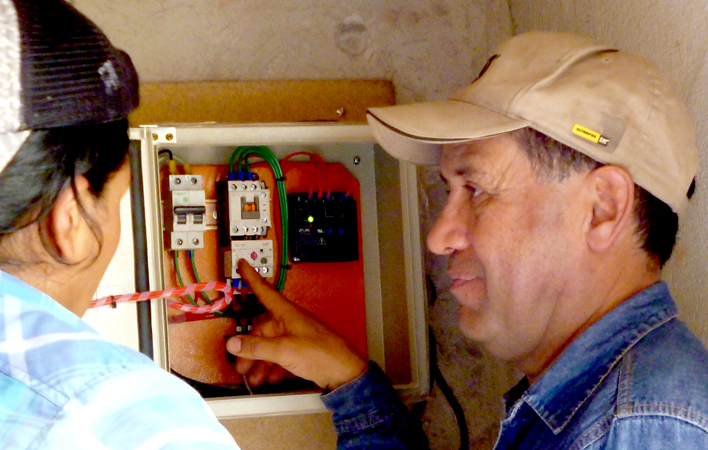 Caiza tells of receiving a jolt of electrical current “that left my legs tingling afterwards” when his finger strayed a bit too close to a live wire. Cortez casually responds, “Yes, it goes all the way to the legs with 220 volts. If it’s 110, it only leaves tingling in the arms.”
Not much more is said as the two Ecuadorians settle in to working together as they have done on many such projects across Ecuador. Their relationship, enduring and long lasting, began when Caiza was a youngster.
“I remember when ‘Eddie’ was a little boy following his father,” Cortez said, recalling how in 1999 Reach Beyond helped Caiza’s mountain community with a project similar to that of Yalare in Ecuador’s coastal lowlands.
Edison’s father, Francisco Caiza, asked for and received training from former Reach Beyond engineer Bruce Rydbeck to become a water technician. Eventually these were footsteps for Edison to follow as well, learning from Cortez the hands-on work and how to direct community volunteers while installing a clean water system.
The scenario came full circle in 2013 when the Caizas embraced an opportunity to accompany Cortez to La Bruyère in northern Haiti and facilitate the work on establishing a system to distribute clean spring water to community members. The Ecuadorian father-son team of Francisco and Edison crossed geographic, language and cultural barriers to help Haitians learn about work, water and a relationship with Jesus Christ.
Of the Caizas’ work in Haiti, Cortez said at the time, “I’m amazed at how Edison and Francisco pray and give testimony of God’s help to the people.” Amazed perhaps, but satisfied to see his investments of time and teaching result in physical as well as spiritual benefits. Arriving at Yalare for the water system’s inauguration, Cortez had already met with a San Lorenzo pastor, Campos, who himself disciples and mentors other pastors.
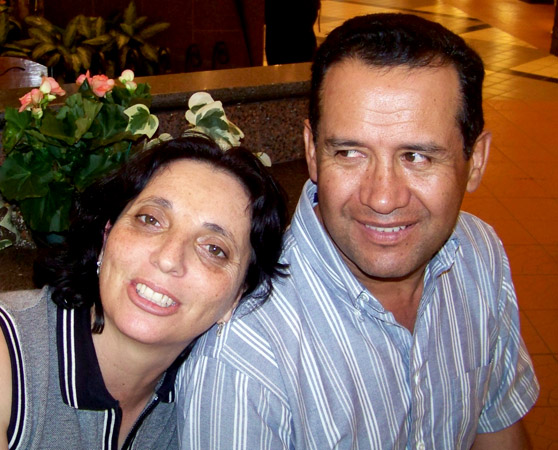 Cortez and his wife, Nancy, who recently retired from Reach Beyond after 22 years of service, have helped Ecuadorian pastors learn how to better shepherd their congregations. For César an aspect of this has been continuing education short courses in Bible study methods and spiritual leadership.
Nancy teaches Christian education workshops using the active learning approach (learning by doing), and she has been active in the Academia Cristiana del Aire (Christian Academy of the Air, formerly the Bible Institute of the Air) which couples radio programs with correspondence courses that teach the Bible.
Seeing a strong relationship between community development work (such as clean water) and Christian discipleship, the Cortezes have also helped improve water systems and hygiene for families throughout Ecuador.
“Our work doesn’t only address water needs,” César told HCJB Radio in an interview. “We strive for a holistic ministry—something complete. We’re trying to bring not just physical but also spiritual health, especially in the north [of Esmeraldas province], and little by little we have moved south. We’ve helped build churches and evangelize; there has been a very good response in Esmeraldas.”
By early afternoon in Yalare, Cortez and Caiza have already visited families who enjoy their community’s clean water system. A boy scrubs his body with soap by the spigot; at another home a couple enthusiastically greets Cortez.
Pictures are taken as clean water streams from a tap. There is time before the ceremony, so they retire to a set of rooms that served to house Caiza while he worked on the project. Once a hotel, the second floor slopes toward one end—effects of an April 2016 earthquake that devastated two of Ecuador’s coastal provinces.
With wasps buzzing in an adjacent room, Caiza talks with Cortez about the challenges of finishing his high school education as an adult. The elder Ecuadorian had advised Caiza about electrical wiring in the morning; now the advice is about life, and meetings its many challenges one by one. Then they meander toward a basketball court where music blaring from speakers tells residents that their village is having an event.
The ceremony involves speeches, recognitions, prayers, music, dancing and food. But the impact of the clean water system is ongoing, improving people’s living conditions. The flow of clean water demonstrates how a liquid can promote health and life instead of illness and death. Members of the local evangelical church may use this to point others to the one who called Himself the “living water” and compassionately handled people’s needs for food, drink and health.
“In all of the projects we do,” Cortez told HCJB Radio, “after the research and design, we train the people of the community, because in the future they can carry out the system maintenance. In each place, we leave a technical and administrative team and even the ability—if they want to—to construct another system or enlarge their own.”
Cortez drops Caiza off at a highway junction to grab a bus for home in a neighboring province. After a few hours of highway time across Esmeraldas province, around dusk Cortez can be found with a local leader from Tonchigüe.
Another clean water project is taking shape under Cortez’s guidance. At one point, he draws on the ground to offer design ideas. They’d like to get clean water from a well over to a hill, then have it flow by gravity through pipes down into a town neighborhood.
During each project phase and afterwards, there are likely to be opportunities for César and Nancy to talk of what motivates them to help Ecuadorians. They will have an apt example—water—and will have earned people’s confidence so that they may talk of Jesus.
After completing their home ministry assignment in the U.S., the Cortezes will return to Ecuador where they plan to serve Ecuadorians through the U.S.-based agency, Commission to Every Nation (CTEN).
Sidebar: ‘With Greater Darkness, the Light of Jesus Is Blazing’
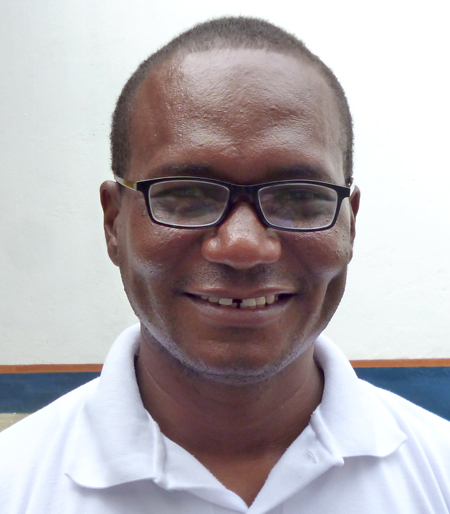 Interviewed by Reach Beyond in San Lorenzo, Ecuador, Pastor Germán Campos spoke of his ministry that began 16 years ago when he met with missionary engineer César Cortez, visiting Esmeraldas province to train church leaders and build water projects. This interview followed a talk by Campos who arrived for a weekly gathering of a network of churches, Comunidad Cristiana Roca de Eternidad (Eternal Rock Christian Community). After the meeting, the pastors traveled by boat to their remote villages on the Verde, Borbón and Onzole rivers and other communities in the province of Esmeraldas.
Your church is really a group of churches—a family of churches—is that right, pastor?
Yes. Today there are 14 churches from the different communities where God has allowed us as Comunidad Cristiana Roca de Eternidad to serve Him. We meet once a week to fellowship together, but also to share with each other the concerns we have. The idea is to encourage them, hear of their needs and see how we can help them. It all began as one small church of eight people. But God helped—and continues helping us—so we’re thankful to the Lord for the life of brother César Cortez who helped us with the basic library and training. From that, I wanted to start planting a small church in each community. And thank God, they have grown. Now we have 14 churches with 14 pastors who have been trained, received [thelogical] libraries and attended different seminaries here in the country.
So that is to say, you offered the pastors a workshop and invited them to it here in the city?
Of course, we did it here so that we could have more coverage. Because of the distances, we needed to, and so by having them come here to a central point, it works. So everyone came and received the training, and that was very motivating. We also to listen to their needs. We have some capabilities to help [and] there are plenty of needs.
Why is it called a “community” of churches?
It’s called “community” for this reason: community is a union of two words. First, it refers to people who have something in common [which could be physical proximity or being from the same province or state]. But the second part [of the word community] is that these people are living together in unity.
Could you talk about the needs that you and your fellow pastors see?
In greater darkness, with denser darkness, what we have seen is that the light of Jesus Christ is blazing. San Lorenzo was formerly a city that nobody wanted to come to. For example, when we first arrived there were only eight policemen who went into hiding every evening due to the city’s proximity to Colombia where there are guerrillas and paramilitaries. The delinquency rate was tremendous. However, we have seen how, little by little, the churches have been growing. After only four [evangelical] churches in the beginning, we are already 17 churches alone here in the county seat [including Comunidad Cristiana Roca de Eternidad and others.]
Additionally, around all the cantones there are already about 250 churches that have been established. So we’re seeing things develop in comparison with 16 years ago when the northern area [of Esmeraldas province] was abandoned and neglected. Today we see highways, bridges, hospitals—and that is no accident. It is due to light shining into darkness when the gospel reaches a community. That is because the gospel transforms the ideology, the thought and the life of the whole community. That’s what happened in the whole northern area [of Esmeraldas province].
What else would you like to add?
Just ask for more folks to help us. We want to continue preparing leaders and helping with the children here in the north [of Esmeraldas province]. The need remains large just as the Lord Jesus Christ said, “The harvest is great, but the workers are few.” So we are very focused on preparing workers, and that means investing in their lives. We have to move them to the cities because we do not have a seminary here. So they need to move to Esmeraldas [the city] or Quito. At times this is a big issue [helping develop people into Christian leaders] for us because the need—poverty among children—is growing every day. These days through Compassion International we have 4,700 children who are receiving help. One might say enough is being done. But realize this: Thousands and thousands more are still in need. So we want to seize the opportunity before us, and we’d like people to join in, to help. We’d like for people to join us in this plan of God … because it is of God.
Source: Reach Beyond
Caiza tells of receiving a jolt of electrical current “that left my legs tingling afterwards” when his finger strayed a bit too close to a live wire. Cortez casually responds, “Yes, it goes all the way to the legs with 220 volts. If it’s 110, it only leaves tingling in the arms.”Not much more is said as the two Ecuadorians settle in to working together as they have done on many such projects across Ecuador. Their relationship, enduring and long lasting, began when Caiza was a youngster.
“I remember when ‘Eddie’ was a little boy following his father,” Cortez said, recalling how in 1999 Reach Beyond helped Caiza’s mountain community with a project similar to that of Yalare in Ecuador’s coastal lowlands.
Edison’s father, Francisco Caiza, asked for and received training from former Reach Beyond engineer Bruce Rydbeck to become a water technician. Eventually these were footsteps for Edison to follow as well, learning from Cortez the hands-on work and how to direct community volunteers while installing a clean water system.
The scenario came full circle in 2013 when the Caizas embraced an opportunity to accompany Cortez to La Bruyère in northern Haiti and facilitate the work on establishing a system to distribute clean spring water to community members. The Ecuadorian father-son team of Francisco and Edison crossed geographic, language and cultural barriers to help Haitians learn about work, water and a relationship with Jesus Christ.
Of the Caizas’ work in Haiti, Cortez said at the time, “I’m amazed at how Edison and Francisco pray and give testimony of God’s help to the people.” Amazed perhaps, but satisfied to see his investments of time and teaching result in physical as well as spiritual benefits. Arriving at Yalare for the water system’s inauguration, Cortez had already met with a San Lorenzo pastor, Campos, who himself disciples and mentors other pastors.
Cortez and his wife, Nancy, who recently retired from Reach Beyond after 22 years of service, have helped Ecuadorian pastors learn how to better shepherd their congregations. For César an aspect of this has been continuing education short courses in Bible study methods and spiritual leadership.Nancy teaches Christian education workshops using the active learning approach (learning by doing), and she has been active in the Academia Cristiana del Aire (Christian Academy of the Air, formerly the Bible Institute of the Air) which couples radio programs with correspondence courses that teach the Bible.
Seeing a strong relationship between community development work (such as clean water) and Christian discipleship, the Cortezes have also helped improve water systems and hygiene for families throughout Ecuador.
“Our work doesn’t only address water needs,” César told HCJB Radio in an interview. “We strive for a holistic ministry—something complete. We’re trying to bring not just physical but also spiritual health, especially in the north [of Esmeraldas province], and little by little we have moved south. We’ve helped build churches and evangelize; there has been a very good response in Esmeraldas.”
By early afternoon in Yalare, Cortez and Caiza have already visited families who enjoy their community’s clean water system. A boy scrubs his body with soap by the spigot; at another home a couple enthusiastically greets Cortez.
Pictures are taken as clean water streams from a tap. There is time before the ceremony, so they retire to a set of rooms that served to house Caiza while he worked on the project. Once a hotel, the second floor slopes toward one end—effects of an April 2016 earthquake that devastated two of Ecuador’s coastal provinces.
With wasps buzzing in an adjacent room, Caiza talks with Cortez about the challenges of finishing his high school education as an adult. The elder Ecuadorian had advised Caiza about electrical wiring in the morning; now the advice is about life, and meetings its many challenges one by one. Then they meander toward a basketball court where music blaring from speakers tells residents that their village is having an event.
The ceremony involves speeches, recognitions, prayers, music, dancing and food. But the impact of the clean water system is ongoing, improving people’s living conditions. The flow of clean water demonstrates how a liquid can promote health and life instead of illness and death. Members of the local evangelical church may use this to point others to the one who called Himself the “living water” and compassionately handled people’s needs for food, drink and health.
“In all of the projects we do,” Cortez told HCJB Radio, “after the research and design, we train the people of the community, because in the future they can carry out the system maintenance. In each place, we leave a technical and administrative team and even the ability—if they want to—to construct another system or enlarge their own.”
Cortez drops Caiza off at a highway junction to grab a bus for home in a neighboring province. After a few hours of highway time across Esmeraldas province, around dusk Cortez can be found with a local leader from Tonchigüe.
Another clean water project is taking shape under Cortez’s guidance. At one point, he draws on the ground to offer design ideas. They’d like to get clean water from a well over to a hill, then have it flow by gravity through pipes down into a town neighborhood.
During each project phase and afterwards, there are likely to be opportunities for César and Nancy to talk of what motivates them to help Ecuadorians. They will have an apt example—water—and will have earned people’s confidence so that they may talk of Jesus.
After completing their home ministry assignment in the U.S., the Cortezes will return to Ecuador where they plan to serve Ecuadorians through the U.S.-based agency, Commission to Every Nation (CTEN).
Sidebar: ‘With Greater Darkness, the Light of Jesus Is Blazing’
Interviewed by Reach Beyond in San Lorenzo, Ecuador, Pastor Germán Campos spoke of his ministry that began 16 years ago when he met with missionary engineer César Cortez, visiting Esmeraldas province to train church leaders and build water projects. This interview followed a talk by Campos who arrived for a weekly gathering of a network of churches, Comunidad Cristiana Roca de Eternidad (Eternal Rock Christian Community). After the meeting, the pastors traveled by boat to their remote villages on the Verde, Borbón and Onzole rivers and other communities in the province of Esmeraldas.Your church is really a group of churches—a family of churches—is that right, pastor?
Yes. Today there are 14 churches from the different communities where God has allowed us as Comunidad Cristiana Roca de Eternidad to serve Him. We meet once a week to fellowship together, but also to share with each other the concerns we have. The idea is to encourage them, hear of their needs and see how we can help them. It all began as one small church of eight people. But God helped—and continues helping us—so we’re thankful to the Lord for the life of brother César Cortez who helped us with the basic library and training. From that, I wanted to start planting a small church in each community. And thank God, they have grown. Now we have 14 churches with 14 pastors who have been trained, received [thelogical] libraries and attended different seminaries here in the country.
So that is to say, you offered the pastors a workshop and invited them to it here in the city?
Of course, we did it here so that we could have more coverage. Because of the distances, we needed to, and so by having them come here to a central point, it works. So everyone came and received the training, and that was very motivating. We also to listen to their needs. We have some capabilities to help [and] there are plenty of needs.
Why is it called a “community” of churches?
It’s called “community” for this reason: community is a union of two words. First, it refers to people who have something in common [which could be physical proximity or being from the same province or state]. But the second part [of the word community] is that these people are living together in unity.
Could you talk about the needs that you and your fellow pastors see?
In greater darkness, with denser darkness, what we have seen is that the light of Jesus Christ is blazing. San Lorenzo was formerly a city that nobody wanted to come to. For example, when we first arrived there were only eight policemen who went into hiding every evening due to the city’s proximity to Colombia where there are guerrillas and paramilitaries. The delinquency rate was tremendous. However, we have seen how, little by little, the churches have been growing. After only four [evangelical] churches in the beginning, we are already 17 churches alone here in the county seat [including Comunidad Cristiana Roca de Eternidad and others.]
Additionally, around all the cantones there are already about 250 churches that have been established. So we’re seeing things develop in comparison with 16 years ago when the northern area [of Esmeraldas province] was abandoned and neglected. Today we see highways, bridges, hospitals—and that is no accident. It is due to light shining into darkness when the gospel reaches a community. That is because the gospel transforms the ideology, the thought and the life of the whole community. That’s what happened in the whole northern area [of Esmeraldas province].
What else would you like to add?
Just ask for more folks to help us. We want to continue preparing leaders and helping with the children here in the north [of Esmeraldas province]. The need remains large just as the Lord Jesus Christ said, “The harvest is great, but the workers are few.” So we are very focused on preparing workers, and that means investing in their lives. We have to move them to the cities because we do not have a seminary here. So they need to move to Esmeraldas [the city] or Quito. At times this is a big issue [helping develop people into Christian leaders] for us because the need—poverty among children—is growing every day. These days through Compassion International we have 4,700 children who are receiving help. One might say enough is being done. But realize this: Thousands and thousands more are still in need. So we want to seize the opportunity before us, and we’d like people to join in, to help. We’d like for people to join us in this plan of God … because it is of God.
Source: Reach Beyond
P.O. Box 39800
Colorado Springs, CO 80949-9800
800.873.4859
Colorado Springs, CO 80949-9800
800.873.4859